Insulation Resistance of Dielectric Materials
This investigation measures the leakage within internal PCB layers during exposure of various specimens to a controlled ground-based test environment.
DOWNLOAD
Authored By:
C. M. Mc Brien, S. Heltzel
ESTEC-ESA, Netherlands
Summary
For electrical equipment, current leakage in a printed circuit board (PCB) can result in intermittent or permanent failure. Current leakage can occur due to insulation resistance reduction between adjacent nets on a PCB. A working group of the European Cooperation for Space Standardization is drafting the standard ECSSQ-ST-70-12 on PCB design. Industry represented within this working group uses various design rules to define insulation distance as a function of voltage. The insulation distances are either based on material and design heritage or based on Generic Standard on Printed Board Design IPC-2221 [1]. The investigation involves measuring the leakage current within internal PCB layers Insitu
during exposure of various specimens to a controlled ground-based test environment and a simulated space environment. This novel test method produced results which show breach of insulation resistance within fiber contaminated samples. This proposes a revision of standard IPC-4101 to implement tighter cleanliness requirements of laminate materials. Clean samples exhibit no breach of insulation resistance which confirms the rules proposed in the design standard.
Conclusions
The following conclusions can be drawn based on the general trend of insulation resistance change:
1. The general insulation resistance during THB decreases significantly after thermal cycling. Second set of thermal cycles does not further affect the resistance drop.
2. The insulation resistance of epoxy boards decreases more than for the polyimide boards.
3. Continuous resistance decrease after thermal cycling is not considered a failure of insulation resistance as it does not indicate electromigration.
The following conclusions can be drawn based on the observations of failed individual patterns:
4. No internal or external patterns fail in the THB testing before thermal cycling.
5. About 20 patterns fail on samples of manufacturer A, whereas no significant failures are observed for manufacturer B. The samples made from Arlon 35N are made by both manufacturers and are directly
comparable.
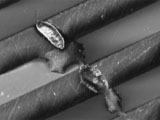
6. For all samples where the defect was found by microsectioning, breach of insulation resistance is associated with fiber contamination, not with dielectric breakdown.
The following general conclusions can be drawn:
7. The design rule of 1 kV per mm insulation distance between internal circuit tracks does not cause dielectric breakdown after thermal cycling with margin, provided that no contamination is present.
8. The requirements for PCB base materials as detailed in IPC-4101C may not be adequate to prevent breach of insulation if worst-case imperfections are indeed present in the PCB. This is a particular concern for space industry because of the high-reliability applications and worst-case environment.
Initially Published in the IPC Proceedings
|