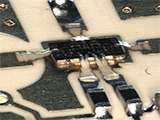
3D Aerosol Jet Printed Interconnects on Bare Die
Aerosol Jet Printing can provide many enhancements over traditional bare die attachment techniques. Previous studies have shown that AJ technology offers advantages in the millimeter wave frequency range, such as a significant reduction of insertion loss and the ability to design the line impedance as required.
DOWNLOAD
Authored By:
Tom Rovere, Chris Torbitt, Joe Jendrisak
Lockheed Martin
NY, USA
Steve Gonya, Emobosan Enka
Binghamton University
NY, USA
Kurt Christenson
Optomec Inc.
MN, USA
Summary
Aerosol Jet [AJ] Printing can provide many enhancements over traditional bare die attachment techniques. Previous studies have shown [1] that that AJ technology offers advantages in the millimeter wave frequency range, such as a significant reduction of insertion loss and the ability to design the line impedance as required.
As more designs venture into the mm-Wave/5G frequencies and higher ranges [2], board real-estate will become a premium. Printed electronics can help alleviate this problem by allowing for bare die to be used instead of standard packaged components. By utilizing printed electronics to form the connection between bare dies and CCA an increase in space of up to 40% can be achieved. For this project the team of Lockheed Martin, Binghamton University, and Optomec worked together to assembly bare die RF beamformer assembly and provided interconnects to the underlying substrate. This report provides an overview of the reason for the printing these interconnects, the overall process of assembling the substrates, the 3D printing of the interconnects, and subsequent testing.
Conclusions
The process for printing interconnects to a bare die has been demonstrated, but there is still more work to be done to optimize the process. The RF results showed comparable performance to a packaged device, but the goal is to see results that show better performance than the packaged device. Unfortunately, failure analysis revealed that ground vias likely caused a 10 dB drop, and an issue with the substrate fabrication affected the receive (Rx) path. Despite these challenges, process parameters will be leveraged to produce a full-up phased array.
Initially Published in the SMTA Proceedings
|