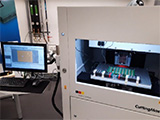
Examination of Cutting-Edge Quality and the Influences of Laser Depaneling
This paper presents an in-depth analysis of potential influences of the cutting quality variation on the characteristics of the printed circuit board.
DOWNLOAD
Authored By:
Patrick Stockbruegger
LPKF Laser & Electronics SE
Lower Saxony, Germany
Jake Benz
LPKF Laser & Electronics North America Inc.
OR, USA
Summary
The price-performance ratio of laser depaneling has continuously improved in recent years and is expected to continue to develop positively in the future. This has further expanded the range of potential applications to include thicker FR4 substrates. During processing, the laser offers the flexibility to adjust performance and quality according to customer requirements by modifying process parameters such as power, frequency and delays. Consequently, the quality can range from a very clean (CleanCut) up to a discolorized and eventually slightly carbonized cutting edge (FastCut). The latest laser depaneling systems are more than competitive with other depaneling processes in terms of cycle time for material thicknesses of up to 1.6 mm.
This paper presents an in-depth analysis of potential influences of the cutting quality variation on the characteristics of the printed circuit board. Therefore, examinations such as a sidewall resistance and breakdown voltage test have been carried out for the two cutting strategies FastCut and CleanCut. Furthermore, a temperature measurement was conducted, along with an optical inspection and an SEM/EDX analysis. The objective of this paper is to conduct a comprehensive analysis of the potential influencing factors and to provide recommendations for users based on the results.
Conclusions
In total it is evident that the temperature range during the laser depaneling process is not critical for the components on the printed circuit board. All measured systems are significantly lower compared to the reflow process or liquidus temperature of the SAC alloy. For heat critical components a minimum distance from the cutting channel is recommended. A rough distance can be estimated by using the equations of the temperature behavior.
In terms of the electrical characteristics, a negative effect could only be observed for the FastCut strategy cutting through the copper traces. By removing these traces, the effect could also be eliminated. For all other measurements no remarkable (negative) effect on the electrical behavior of cutting edge and printed circuit board was found. Consequently, potential negative effects can be avoided by a slight design change or the choice of a suitable cutting strategy.
Initially Published in the SMTA Proceedings
|