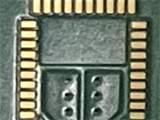
Electromigration in Tin-Bismuth Planar and Bottom Terminated Solder Joints
The electromigration rates and behavior of eutectic Sn-Bi alloy in planar and in BTC solder joints were compared and shown to be similar.
DOWNLOAD
Authored By:
Prabjit Singh, L. Palmer, M. Hamid
IBM Corporation, Poughkeepsie, East Fishkill, NY, and Rochester, MN, USA
R. F. Aspandiar, B. Franco
Intel, Hillsboro, OR, USA
H. Fu
iNEMI, Shanghai, China
V. Vasudevan
Dell Technologies, Round Rock, TX, USA
A. Allen
HP, Inc., Palo Alto, CA, USA
K. Howell
Nihon Superior Co., Ltd., Osaka, Japan
K. Murayama
Shinko Electric Industries Co. LTD., Nagano, Japan
H. Zhang
Indium Corporation, Clinton, NY, USA
A. Lifton
MacDermid Alpha Electronics Solutions, South Plainfield, NJ, USA
Summary
Electromigration monitoring of bottom terminated component (BTC) solder joints is limited to electrical resistance measurements of the solder balls. Tracking the microstructural evolution such as bismuth segregation in tin-bismuth solder ball, is typically via metallurgical cross sectioning, a destructive technique. Once cross sectioned, the solder ball is not available for further electromigration current stressing. A novel planar solder geometry has been invented and developed that allows real-time, non-destructive monitoring of solder microstructure, while the progress of electromigration can be concurrently tracked via electrical resistance means.
Planar solder joints are easy to fabricate in a typical metallurgical laboratory. If the electromigration behavior of the planar and the BTC solder joints happen to be similar, the planar solder joint approach could greatly aid in the quick development of solder alloys by comparing the rates of electromigration and the metallurgical changes in planar solders of various compositions. In this paper, the electromigration rates and behavior of eutectic Sn-Bi alloy in planar and in BTC solder joints were compared and shown to be similar. This important finding opens the use of planar solder joints for the quick and low-cost development of low-temperature solder alloys.
Conclusions
The study concluded that the planar and the bottom terminated component (BTC) solder joints have very similar electromigration behavior. They both show an initial period of decreasing electrical resistance in the early stages of the test under low temperature and low electric current density conditions. At high temperatures and high current densities this initial period of decreasing electrical resistance shortens. The Arrhenius plots that conveniently sum up the effect of temperature and current density on electromigration are also very similar for the planar and the BTC solder joints.
Planar solder joints are easy to fabricate. They allow the monitoring of electromigration and microstructure changes simultaneously with electrical resistance changes. BTC solder joints are much more complicated to fabricate. In addition, the electromigration behavior of bottom terminated component solder joints can only be tracked by their electrical resistance. The conclusion that the electromigration behavior of planar and BTC solder joints is similar is very beneficial: It allows the use of the easier to fabricate planar solder joints to study the electromigration behavior of various solder metallurgies. The development of solder metallurgies can thus be greatly shorted and can be conducted at much lower cost.
Initially Published in the SMTA Proceedings
|