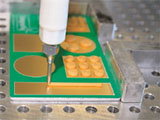
Liquid Dispensed Thermal Materials for High Volume Manufacturing
This paper presents the science behind liquid TIMs identifies key TIM characteristics needed to design and manufacture reliably and efficiently.
DOWNLOAD
Authored By:
Dr. Sanjay Misra
Sr. Scientific Principal, Adhesive Technologies, Henkel Corporation
18930 W 78th Street, Chanhassen, MN 55317, USA
Summary
Industry 4.0, autonomous vehicles and 5G connectivity are driving a new Internet of Things (IoT) revolution. Assembly materials like thermal interface materials (TIMs) need to be selected keeping in mind both performance as well as economics viability. With higher volumes of various device designs, automated manufacturing and adaptable materials are also critical factors is the price-performance equation. Uniquely, liquid dispensed thermal interface materials (TIMs) are an optimal approach to address this convergence of high performance and cost-competitive manufacturing.
Adaptable attributes – such as curable or non-reactive – make liquid TIM materials well-suited for a variety of applications. This paper presents the basic science behind liquid TIMs identifies key TIM characteristics needed to design and manufacture reliably and efficiently, and illustrates the relationship between material properties, performance and manufacturing compatibility. Fundamental differences between solid, pad-like materials and unfilled liquids will be highlighted.
Conclusions
While the specification of TIM performance is driven by electronic design, one must also optimize manufacturing. Liquid TIMs offer not only better thermal performance, due to lower modulus during assembly and better wet out, but also allow increased manufacturing efficiencies. Better inventory management, automation optimization and quality control are possible with liquid TIMs, which are available in several formats to address both performance and manufacturing attributes. For the successful startup of a line, attention must be paid to storage, handling and dispensing these materials due to the particulate filler. These issues should be collectively addressed by TIM manufacturers, equipment manufacturers and the end user. There are several technically and economically viable solutions for automated dispensing of liquid TIMs on the market.
Initially Published in the SMTA Proceedings
|