Ultra Low Profile Copper Foil for Very Low Loss Material
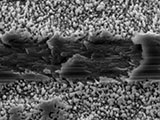
A new almost no profile copper foil has been developed to achieve this property while maintaining a good adhesion with low loss resins. Electrodeposited copper foil production is divided in two steps. First, the foil is plated on a titanium drum from a copper sulfate solution. Then a treatment is applied to increase roughness and ensure oxidation resistance.
DOWNLOAD
Authored By:
Thomas Devahif
Circuit Foil
Wiltz, Luxembourg
Summary
Copper foil roughness has become a significant factor influencing conductor loss in high speed PCBs, particularly as they move above the 50 GHz range. At high frequencies, the current tends to flow mostly on the surface of the conductor (skin effect). When the so-called skin depth reaches the same dimensions as the roughness profile of the foil, the current follow its contour, inducing additional loss due to the longer propagation path. For regular very low profile copper foil, the roughness is around 3.0 μm (Rz ISO), meaning that the loss becomes significant at frequencies close to 1 GHz. To achieve good results over 20 GHz, the prof ile roughness must be below 1.25 microns.
A new almost no profile copper foil has been developed to achieve this property while maintaining a good adhesion with low loss resins. Electrodeposited copper foil production is divided in two steps. First, the foil is plated on a titanium drum from a copper sulfate solution. Then a treatment is applied to increase roughness and ensure oxidation resistance. By using organic additives in the plating bath, the structure of the product can be controlled. Copper foils with a roughness below 1.25 μm have been obtained with a mixture of additives. Further improvement was achieved with titanium drums that had been polished with a specific grinding wheel to achieve a lower roughness on their surface.
The adhesion is usually increased with the treatment step by applying nodular copper particles. However, regular treatments have a significant impact on the roughness and therefore on the signal loss. A good compromise between adhesion and transmission properties was achieved with a specific nodular deposit. For ultra-low loss application, a version of the foil without treatment is also under development. Sufficient adhesion is ensured by silanebased coupling agent or organic coating.
Conclusions
Almost no profile copper foil has been developed with both plating and treatment improvement. The use of specific additives and low roughness drums for the base foil production resulted in a decrease of 0.3 microns in roughness compared to previous products. Sufficient adhesion (0.5 N/mm) was obtained with a very low profile nodular treatment having little impact on both roughness and insertion loss.
The use of white-light scanning interferometry ensured an accurate measurement of the foil's roughness. Unlike stylus method, this method provided results in good correlation with the insertion loss measurements.
Initially Published in the SMTA Proceedings
Comments
May 21, 2021
What is the "cost penalty" for this almost-no-profile-copper? There are other versions of very low profile Cu and a lot of OEM's have determined that the price/performance tradeoff isn't justifiable. If this is a minimum price increase, there may be interest from the OEM community.
James Brown, GreenSource Fabrication
|