Process Control of Ionic Contamination in Assembly of Electronic Circuits
This paper reviews a testing protocol based on IPC-TM 650 2.3.25 to enable monitoring of ionic contamination within series production.
DOWNLOAD
Authored By:
P. Eckold, L. Henneken, R. Fritsch, U. Welzel
Robert Bosch GmbH, Automotive Electronics, Stuttgart, Germany
M. Routley, G. Naisbitt
Gen3 Systems Limited, Farnborough, UK
Summary
This paper reviews a newly developed testing protocol based on IPC-TM 650 2.3.25, established to enable monitoring of ionic contamination within series production.
The testing procedure was successfully implemented within the production of high reliability, safety critical electronic circuits, involving multiple production sites around the world. I will be shown in this paper that the test protocol is capable for meeting Six-Sigma-Criteria.
For a Gauge R&R study, a calibration solution of 0.1 wt.-% NaCl was used in order to investigate the repeatability and reproducibility of the test protocol employing newly developed contamination testing systems, which were placed at five locations worldwide. A total failure range of below 0.1 micrograms/cm squared congruent to NaCl at a target value of 1.0 micrograms/cm squared congruent to NaCl (plus or minus 8.8%) was achieved, combined with manual laboratory handling of fluids (pipette, temperature).
For process control this value is acceptable and demonstrates that ionic contamination testing based on IPC-TM 650 2.3.25 is able to be used as a process control tool in manufacturing of electronic control units.
Conclusions
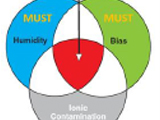
As previously emphasised, electrochemical migration is caused by an electric field and a closed water film between neighbouring conductive paths. Ionic contamination is given by materials and processes and can accelerate the electrochemical processes under high temperature and high humidity conditions. Consequently, the measurement of ionic contamination does not predict the humidity reliability of printed board assemblies. The humidity robustness of design elements can be ensured by SIR measurement technology according to the principle of IPC 9202.
The implementation of ionic contamination testing as process control tool (PICT) exhibits advantages to current ROSE test protocols. Due to system optimization and the implementation of unified work place instructions, it was possible to achieve 6σ criteria for the repeatability and a sufficient reproducibility of recorded ionic contamination data at five different production sites worldwide. Using this approach, process control and methods of process optimizations are possible.
Initially Published in the IPC Proceedings
|