circuitnet
Sponsor
Advanced Interconnections Corp.
Plan Ahead for BGA Device Upgrades
BGA Socket Adapter Systems convert surface mount device packages to through-hole (pinned) assemblies, making it easy to plug and unplug SMT devices in the field or the test lab.
Advanced Interconnections Corp.
Rentals and Rent to Purchase x-ray Systems
Sponsor
ECD
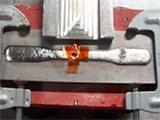
Maybe it's the thermocouple connection
If your thermal profiling readings seem inconsistent, the culprit could be your thermocouple attachment method. A recently conducted study revealed some interesting findings.
ECD

Microalloyed Sn-Cu Pb-Free Solder for High Temperature


Microalloyed Sn-Cu Pb-Free Solder for High Temperature
This paper features a study of microstructural evolution during elevated temperature aging and the growth of intermetallics between Cu and Ni substrates.

DOWNLOAD

Authored By:

Keith Howell1, Keith Sweatman, Motonori Miyaoka, Takatoshi Nishimura
Nihon Superior Co., Ltd., Osaka, Japan

Xuan Quy Tran, Stuart McDonald, and Kazuhiro Nogita
The University of Queensland, Brisbane, Australia

Summary

While the search continues for replacements for the highmelting-point, high-Pb solders on which the electronics industry has depended for joints that maintain their integrity at high operating temperatures, an investigation has been made into the feasibility of using a hypereutectic Sn-7Cu in this application.

While its solidus temperature remains at 227 degrees C the microstructure, which has been substantially modified by stabilization and grain refining of the primary Cu6Sn5 by microalloying additions of Ni and Al, makes it possible for this alloy to maintain its integrity and adequate strength even after long term exposure to temperatures up to 150 degrees C.

In this paper the results of a study of microstructural evolution during elevated temperature aging and in particular the growth of intermetallics at the interface between Cu and Ni substrates will be reported as well as the results of elevated temperature mechanical testing.

Conclusions

The results reported here indicate that a Sn-7Cu alloy in which the particle size of the primary Cu6Sn5 phase has been refined by an addition of Al appears to have strength at least comparable with that of Sn-95Pb at temperatures up to 220 degrees C. The reduction in strength that occurs as the Cu6Sn5 coarsens suggests that the relatively high strength of the Sn7Cu alloy results from the fine dispersion of Cu6Sn5 particles that results from the controlled addition of Al.


Initially Published in the SMTA Proceedings

Submit A Comment


Comments are reviewed prior to posting. You must include your full name to have your comments posted. We will not post your email address.

Your Name


Your Company
Your E-mail


Your Country
Your Comments


Free Newsletter Subscription
Circuitnet is built for professionals who bear the responsibility of looking ahead, imagining the future, and preparing for it.

Insert Your Email Address

Sponsor
Uyemura
RAIG Minimizes Corrosion, Allows Higher Gold on ENEPIG
Paper describes a mixed reaction RAIG electrolyte that minimizes galvanic corrosion and allows higher ENEPIG gold thicknesses, enabling robust designs and world-class quality on target with minimal variation.
Uyemura
Affordable Profiling