Reworkable Edge Bond Adhesives for BGA Applications
Reworkable edge bond materials designed to improve the reliability of large area BGAs and ceramic BGAs assemblies are presented.
DOWNLOAD
Authored By:
Fei Xie, Ph.D., Han Wu, Daniel F. Baldwin, Ph.D., Swapan Bhattacharya, Ph.D., and Kelley Hodge Engent, Inc.
Norcross, GA, USA
Qing Ji, Ph.D
H. B. Fuller
Yantai, Shandong, China
Summary
Reworkable edge bond adhesives are finding increasing utility in high reliability and harsh environment applications. The ASICs and FPGAs often used in these systems typically require designs incorporating large BGAs or ceramic BGAs. For these high reliability and harsh environment applications, these packages typically require underfill to achieve the needed thermal cycle, mechanical shock and vibration reliability.
Moreover, these applications often incorporate high dollar value printed circuit boards (on the order of thousands or tens of thousands of dollars per PCB) hence the need to rework these assemblies and maintain the integrity of the PCB and high dollar value BGAs. This further complicates the underfill requirements with a reworkablity component. Reworkable underfills introduce a number of process issues that can result in significant variability in reliability performance. In contrast, edge bond adhesives provide a high reliability solution with substantial benefits over underfills.
This paper presents a study of new high performance reworkable edge bond materials designed to improve the reliability of large area BGAs and ceramic BGAs assemblies while maintaining good reworkablity. Four reworkable edge bond materials (commercially available) were studied. Test vehicles included 12mm BGAs with plans to expand the study to include ceramic BGAs and large area BGAs. Process development was also conducted on the edge bond process to determine optimum process conditions.
For edge bond processing, establishing an edge bond that maximizes bond area without encapsulating the solder balls is key to achieving high reliability. The reliability testing protocol used included board level thermal cycling (-40 to 125 degrees C) and random vibration testing (3 G, 10 - 1000 Hz).
Conclusions
Edge bond adhesives provide an attractive alternative to traditional reworkable underfills for BGA, CSP, WLCSP and BTN components. Moreover they significantly reduce the complexity of the encapsulation process for reliability improvement. Effectively eliminating typical concerns with underfill processing including flux selection, flux-underfill compatibility, underfill voiding, underfill flow time, underfill delamination, and solder extrusion into underfill voids during thermal and power cycling. The edge bond dispensing process is also considerably easier than underfilling.
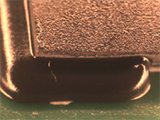
"L" shaped dispense patterns are used to deposit edge bond on the component corners and anchor them down. The current work focused on processing thixotropic materials having minimal flow under the components thereby mitigating possible stress concentrations due to partial solder ball encapsulation.
New edge bond adhesives have properties tailored to high reliability performance and a variety of applications. Materials with a range of Tg, modulus and CTE values are available. This study used edge bond materials with Tg values ranging from 74 to 124 degrees C and alpha one CTE values ranging from 30 to 57 ppm/ degrees C. In addition, edge bond adhesives provided excellent reworkability and a considerably simpler rework process compared with reworkable underfills.
The materials tested show excellent to very good performance in thermal cycle testing exceeded 2000 cycles for Matls A and D. Moreover, the materials tested showed robust performance in random vibration testing passing for 90 min with a peak acceleration of 3G.
Initially Published in the SMTA Proceedings
Comments
Nov 12, 2018
We have seen solder ball crack after drop test on large package.
Lwin Tint, Cisco
|