Evaluating Manual and Automated Heat Sink Assembly
This paper illustrates the use of strain gauge testing and Finite Element Analysis as a simulation tool to optimize the heat sink assembly process.
DOWNLOAD
Authored By:
Michael Randy Sumalinog
AEG-Asia, Flextronics Manufacturing Co.
Guangdong, Zhuhai, China
Jesus Tan, Murad Kurwa
AEG, Flextronics International Inc.
Milpitas, CA, USA
Summary
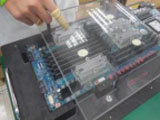
Proper assembly of components is critical in the manufacturing industry as it affects functionality and reliability. In a heat sink assembly, a detailed manual process is often utilized. However, an automated fixture is used whenever applicable. This paper will illustrate the use of strain gauge testing and Finite Element Analysis (FEA) as a simulation tool to evaluate and optimize the heat sink assembly process by manual and automated methods.
Several PCBAs in the production line were subjected to the manual and automated assembly process. Strain gauge testing was performed and FEA models were built and run. Results were compared with the goal of improving the FEA model. The updated FEA model will be used in simulating different conditions in assembly. Proposed improvement solutions to some issues can also be verified through FEA.
Conclusions
The finite element models for FEA of a heat sink assembly by manual and automated processes have been presented in this paper. Based on results, automated assembly is preferred than the manual assembly process. The results of the analysis were compared to experimental data gathered through strain gauge testing. After several iterations, the differences between experimental and numerical results were reduced and trends were noted to achieve optimized FE models. These FE models can be used to perform other studies to improve strain values and avoid damaging board flexure. One such factor is the location of the BGAs on the printed circuit board.
Initially Published in the IPC Proceedings
|