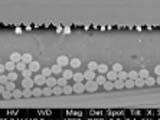
Analysis of Laminate Material Properties for Correlation to Pad Cratering
In this study, two Pb-free-compatible laminates were tested, with one dicy-cure non-Pb-free-compatible as control.
DOWNLOAD
Authored By:
Carlos Morill, Yan Ning, Michael Pecht, Michael H. Azarian
University of Maryland, Center for Advanced Life Cycle Engineering (CALCE)
College Park, MD USA
Julie Silk
Keysight Technologies
Santa Rosa, California
Summary
Pad cratering failure has emerged due to the transition from traditional SnPb to SnAgCu alloys in soldering of printed circuit assemblies. Pb-free-compatible laminate materials in the printed circuit board tend to fracture under ball grid array pads when subjected to high strain mechanical loads. In this study, two Pb-free-compatible laminates were tested, plus one dicy-cure non-Pb-free-compatible as control. One set of these samples were as-received and another was subjected to five reflows.
It is assumed that mechanical properties of different materials have an influence on the susceptibility of laminates to fracture. However, the pad cratering phenomenon occurs at the layer of resin between the exterior copper and the first glass in the weave. Bulk mechanical properties have not been a good indicator of pad crater susceptibility. In this study, mechanical characterization of hardness and Young's modulus was carried out in the critical area where pad cratering occurs using nano-indentation at the surface and in a cross-section.
The measurements show higher modulus and hardness in the Pb-free-compatible laminates than in the dicy-cured laminate. Few changes are seen after reflow - which is known to have an effect - indicating that these properties do not provide a complete prediction. Measurements of the copper pad showed significant material property changes after reflow.
Conclusions
This paper presents initial results of an effort to correlate pad cratering to the mechanical properties of laminate materials using nano-indentation. This method allows measurement in the localized resin layer where the fractures occur. Mechanical property measurements in the cross-section were higher than those made in the exposed resin on the surface, possibly due to the surface roughness. Both measurement locations showed the same trends:
It was found that phenolic-cured laminates had higher stiffness and hardness than the dicy cured laminate, as expected. The sample that has filler in the resin showed a decrease in Young's modulus after reflow, suggesting that the filler has an effect on the hardness change.
The lack of material change for the resins without filler does not match the pad crater susceptibility test results and experience expected: there is consistently an increase in susceptibility with reflows. The copper pad measurements showed that the hardness decreased after reflow for all samples. The as-received Young's modulus for the dicy-cured sample was significantly lower than for the Pb-free-compatible laminates and increased after reflow. This change could affect reliability of the copper.
It does not appear that Young's modulus or hardness correlate directly with pad crater susceptibility, although additional study would be helpful. The effect of lamination and reflow processes on material properties of the copper warrants additional study.
This study demonstrates that nano-indentation is a fast assessment technique to measure mechanical properties of laminate materials. This work obtains Young's modulus and hardness values in situ from a PCB as received and after reflow process, and look for a correlation between these mechanical properties and pad cratering.
Initially Published in the IPC Proceedings
Comments
Dec 29, 2016
There are many FR-4 phenolic cured products that are commercially available. These products were developed by using fracture toughness G1C and K1C measurements. It would have been great to see how these materials would have performed with this new test.
Douglas J. Sober, Essex Technologies Group, Inc.
|