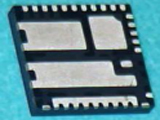
Reliability Study of Bottom Terminated Components
This paper covers the impact of voiding on solder joint reliability and the impact of voiding on the heat transfer characteristics for BTC components.
DOWNLOAD
Authored By:
Jennifer Nguyen, Hector Marin, David Geiger, Anwar Mohammed, and Murad Kurwa
Flextronics International
Milpitas, CA, USA USA
Summary
Bottom terminated components (BTC) are leadless components where terminations are protectively plated on the underside of the package. They are all slightly different and have different names, such as QFN (quad flat no lead), DFN (dual flat no lead), LGA (land grid array) and MLF (micro lead-frame. BTC assembly has increased rapidly in recent years. This type of package is attractive due to its low cost and good performance like improved signal speeds and enhanced thermal performance.
However, bottom terminated components do not have any leads to absorb the stress and strain on the solder joints. It relies on the correct amount of solder deposited during the assembly process for having a good solder joint quality and reliable reliability. Voiding is typically seen on the BTC solder joint, especially on the thermal pad of the component. Voiding creates a major concern on BTC component's solder joint reliability. There is no current industry standard on the voiding criteria for bottom terminated component.
The impact of voiding on solder joint reliability and the impact of voiding on the heat transfer characteristics at BTC component are not well understood. This paper will present some data to address these concerns. We will present our study on the thermal cycling reliability of bottom terminated components, including non-symmetrical LGA and QFN components. Two different solder process conditions and different voiding levels were included in the study, and the results will be discussed. The paper also covers our thermal modeling study of the heat transfer characteristic of BTC component.
Conclusions
The study showed that voids did not initiate cracks in the solder joint of BTC components during thermal cycle testing from 0 degrees C to 100 degrees C. The data did not show that voids facilitate solder joint failure. Solder joints of small signal pins typically had more severe cracks and would fail first. Thermal pads usually had more voiding, but lesser cracks were observed after 3000 thermal cycles.
The thermal modeling study indicated that voiding did not significantly impact the temperature increase of the device with power dissipation of about 3Watts. Further analysis would be done evaluating the thermal behavior of other BTC configurations and trying to validate with known performance of real components.
Initially Published in the IPC Proceedings
Comments
Oct 3, 2017
Just wanted to say this is a very helpful paper. I feel calibrated now on how worried to be about the inevitable voids under BTC components, which are the majority of power parts available now.
Philip Hedges, Pavilion Data Systems
|