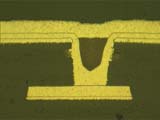
Effects of Dielectric Material, Aspect Ratio and Copper Plating on Microvia Reliability
The effects of dielectric material, aspect ratio, via morphology, surface prep, temperature and copper plating on microvia reliability are evaluated.
DOWNLOAD
Authored By:
Thomas Lesniewski
Northrop Grumman Corp, San Diego, CA
Summary
This paper documents test data on the effects of materials and processes on microvia structures. Thirteen sets of experiments were carried out to evaluate the effects of dielectric material, aspect ratio, via morphology, surface preparation, temperature and copper plating type and thickness on microvia reliability. Reliability was assessed by subjecting boards and coupons to thermomechanical stress using four test methods: hot oil immersion, thermal shock, oven reflow simulation and Interconnect Stress Test (IST).
Conclusions
In this study, microvias were fabricated with different features and stressed to failure. The following is a list of contributing factors to the failures, ranked in order of most likely contribution:
Microvias with higher aspect ratio are less reliable. Microvias with aspect ratio 0.7:1 or less survived accelerated life testing regardless of the dielectric material of construction. Microvias with 1:1 aspect ratio commonly failed after just a few thermal stress cycles.
Dielectric materials. Microvias made with high z-axis CTE dielectrics failed at a higher rate, and it was found that dielectrics with higher z-axis CTE were more susceptible to material property variations.
Capture pad copper composition. Processes that result in an electroless-on-electroless base layer for microvias is prone to premature brittle failure. 0.0003" minimum of electrolytic copper is recommended at the microvia capture pad.
PWB fabricator laser drill and cleaning processes. Processes that yield a relatively flat capture pad will result in lower microvia adhesive strength, relative to roughened surface with some curvature.
Board design and assembly. The more thermal stress cycles that a board sees during PWB and CCA fabrication, including lamination, bake out, oven reflow and rework, the more susceptible they are to microvia failure. For board designs with 3 or more laminations, or ROHS thermal profiles, dielectric material selection is crucial to reliability.
Moisture absorption. Based on limited data, board bake out resulted in fewer failures even with zero blisters or delamination. A possible explanation is that moisture absorbed by the board causes an increase the Z-axis CTE, and stress on the microvia during oven reflow.
Initially Published in the IPC Proceedings
|