In the fast developing electronic industry the demands for production equipment are changing rapidly as well. The industry is looking for both, stable production processes and automated procedures in order to have full control of quality and costs.
This also affects the rework processes that are commonly still related to knowledge and skills of operators who are handling repair and touch-up of electronic assemblies.
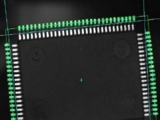
To enable a rework system to carry out automated user independent rework the placement process needs to operate automatically. A new placement technology is introduced here that uses two cameras to identify the target area for component installation as well as the component pin structure. Image processing software calculates the correct placement position for the component out of the image information.
A motorized four axes system is able to move the component to the target position without interaction of any operator. The procedure is based on an automatic pin detection algorithm along with a matching algorithm to find the correct position of the pin pattern in the target image. Several alignment procedures as well as camera corrections are implemented in order to reach the high demands of placement accuracy and repeatability.
The new placement technology relieves the user from exertive optical alignment and time consuming manual adjustment as well as guaranteeing a high repeatability in the positioning results. While the system is placing and installing the component the user can focus on preparative activities.
Besides automatic placement, the described rework technology allows automatic component flux and paste dipping as well as handling of paste printed components. Additionally soldering and desoldering processes are operated automatically.
Compared to the existing methods of component placement and treatment, the new placement technology implemented in a rework system opens up a field to repair complex electronic assemblies. At the same time competitive cameras and stepper motor axes allow to introduce this technology on a more widely accepted price level.
Accuracy and repeatability of the procedures are increasing along with the higher degree of automation in the machine which can operate standard SMT components and bottom terminated components from 1 x 1 mm to 50 x 50 mm without any special tools for desoldering, soldering or placement. No component data needs to be supplied or evaluated; the operator can execute the rework process starting with the first assembly and the first component.
The success rate can easily rise by more than 10% compared to simple, non-automated repair procedures. Automated processes can save up to 30 - 50 % of the operator's time. The alignment of components is done by the rework system and the operator can concentrate on other activities with operator generated alignment mistakes removed reducing defects during rework.