SMT assembly quality is dependent on the consistent release of solder paste. This, in turn, can be greatly impacted by the quality of the stencil.
Stencil quality is traditionally judged by paste release performance. This approach only indirectly measures stencil quality. In a controlled study, using a single stencil design and single PCB type, performance differences between stencils may be identified. However outside of a controlled study, it can be very difficult to determine the quality of the stencil based on the observation of paste depositions as so many other factors affect paste release.
In production, poor stencil quality is often not recognized until defects are generated, with an associated cost. Since print quality is dependent not only on stencil quality, but also on the PCB surface, and screen printer programming, paste quality and many other factors, it is usually time consuming and costly to trace back poor print results to a low quality stencil.
It would advantageous if quality of stencils could be determined using an inspection method which did not require printing solder paste. Previous studies, where a subjective visual or SEM inspection of the aperture walls was performed, have suggested that there is a correlation between the smoothness of the walls and the transfer efficiency.
The goal of this study was to develop a method for the measurement of stencil aperture wall roughness, producing quantifiable results which can predict paste release performance. It is hoped that this method may then be used as a way of gauging the quality of individual stencils, evaluating stencil supplier and fabrication .
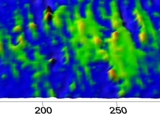
Aperture wall roughness can be measured and quantified using this method. In addition to measuring the roughness over an area, stencil fabrication defects, such as out of spec thickness and slag are easily detected. There appears to be a significant correlation between the Sa of a stencils aperture walls and release volumes based on the limited number of samples printed. While some additional work is needed in order to fine tune the design of the coupon, we believe this will prove helpful in determining the quality of stencils before printing.
The large variation in roughness for stencils cut with the same method indicates the quality of stencils cannot be predicted by specifying a certain fabrication method. For example, it is very clear that all laser cut stencils are not fabricated equally. In discussions with stencil vendors we found out that the type of laser used, the size of the beam, compressor type and cutting speed can greatly impact the quality of the aperture walls.
The manufacturing method and foil type appeared to have less of an impact on wall roughness than the cutting process. We found no evidence that there is any difference between Premium and less expensive 304 based foil stencils. Electroformed stencils, based on this study and informal findings in production, are often thinner than specified. This may be more of a factor in aiding release than the quality of the stencil walls.