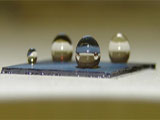
Low Surface Energy Coatings Rewrite Area Ratio Rules
Paper on the properties of solder paste release and the effects of surface free energy that make up the stencil printing process.
DOWNLOAD
Authored By:
Ricky Bennett
Assembly Process Technologies, Flemington, NJ USA
Eric Hanson
Aculon, San Diego, CA USA
Summary
Paste release characteristics are driven by the Area Ratio formula, which is based upon conventional stencil foil materials such as a variety of stainless steel alloys, nickel, etc. The surface energy or "phobic" characteristics of these materials are significantly greater than the newer chemistries used to coat stencils and therefore effectively limits the conventional Area Ratio formula in its ability to predict transfer efficiency in ultra-fine pitch devices.
Conclusions
The purpose of this paper is to break down the components of the stencil system and to highlight and understand the phenomenon of interacting surface free energies. Solder paste printing clearly has an intense set of complex interacting parts that does not lend itself to having a one fix for all. From a stencil specific perspective, stencil materials and surface treatments will play a vital role in successful deposition control, especially with the surface mount assemblies that have greater densities of miniaturized components.
From our perspective, as stencil aperture size decreases, the importance of addressing the issue of surface energy becomes more critical. At the moment, fluorocarbon-based surface treatments are the best method to reduce surface energy, and therefore soiling of the stencil surfaces by solder paste fluxes. Of these treatments, we believe that monolayers of phosphonate-based treatments are likely the optimal balance of performance and cost (from the considerations described above) and the fact that the innate thinness of these treatments creates very few risk factors (they do not appreciably 'crack' or leach into paste and if they are damaged there will be no change to the aperture sizing).
The use of the Area Ratio formula is basic in its approach to understanding deposition capabilities. Highlighting the complexities of the various interacting surfaces and their levels of wetting/repellency to the solder paste, more studies will be needed to establish a true formula that will take in to consideration the variables.
Initially Published in the IPC Proceedings
|