Creep Corrosion of PWB Final Finishes
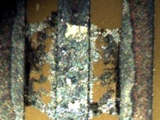
This paper demonstrates that creep corrosion on a PWB is highly surface sensitive.
DOWNLOAD
Authored By:
C. Xu, J. Smetana, J. Franey, G. Guerra, D. Fleming, W. Reents,
Alcatel-Lucent, Murray Hill, NJ and Plano, TX, USA
Dennis Willie, Flextronics, San Jose, CA USA
Alfredo Garcia I., Sanmina-SCI, Mexico
Guadalupe Encinas, Alcatel-Lucent, Nogales, AZ, USA
Jiang Xiaodong, Alcatel Shanghai Bell, Shanghai, PR China
Summary
As the electronic industry moves to lead-free assembly and finer-pitch circuits, widely used printed wiring board (PWB) finish, SnPb HASL, has been replaced with lead-free and coplanar PWB finishes such as OSP, ImAg, ENIG, and ImSn. While SnPb HASL offers excellent corrosion protection of the underlying copper due to its thick coating and inherent corrosion resistance, the lead-free board finishes provide reduced corrosion protection to the underlying copper due to their very thin coating. For ImAg, the coating material itself can also corrode in more aggressive environments. This is an issue for products deployed in environments with high levels of sulfur containing pollutants encountered in the current global market. In those corrosive environments, creep corrosion has been observed and led to product failures in very short service life (1-5 years).
Creep corrosion failures within one year of product deployment have also been reported. This has prompted an industry-wide effort to understand creep corrosion although minimal progress has been made in this effort. This lack of progress has been primarily due to the inability of reproducing creep corrosion in the lab using realistic accelerated aging tests. In this paper, we will demonstrate that creep corrosion on a PWB is highly surface sensitive. Neither clean FR4 nor clean solder mask surfaces support the creep corrosion. In general, the board assembled with rosin wave soldering fluxes and solder paste containing rosin flux is also resistant to the creep corrosion.
However, residue left on the solder mask surface by organic acid flux is highly active and supports the creep corrosion of copper sulfides. The proper choice of the assembly flux can eliminate product failure due to creep corrosion associated with the ImAg plated circuit boards deployed in highly corrosive global environments. Furthermore, mixed flowing gas testing (MFG) provides a realistic accelerated test for simulating the creep corrosion in the laboratory without requiring condensing conditions.
Conclusions
The creep corrosion on printed circuit boards is highly sensitive to the surface chemical properties. Neither clean FR4 nor clean solder mask surfaces support the creep corrosion. In general, the board assembled with rosin wave soldering fluxes and solder paste containing rosin flux is also resistant to the creep corrosion. Residue left on the solder mask surface by the organic acid flux, on the other hand, forms a "creepable" surface and is highly active for supporting the creep corrosion of copper sulfides.
The proper choice of the assembly flux can eliminate product failure due to creep corrosion associated with the ImAg plated circuit boards deployed in highly corrosive global environments. The corrosion test using mixed flowing gases provides a realistic accelerated test for the equipment to be deployed in global environments. No condensing condition is required for simulating the product failure due to the creep corrosion in the laboratory.
Initially Published in the IPC Proceedings
|