Toughened Laminates for Circuit Boards
Paper covers using pre-formed toughening materials in resin formulations.
DOWNLOAD
Authored By:
Lameck Banda, Mark Wilson
Robert Hearn, Michael Mullins
The Dow Chemical Company
Summary
With the miniaturization of electronic devices1, the need for more versatile materials to make these devices increases. Coupled with the gradual removal of lead-based solders2, thermal stability of modern electronics materials is necessary to withstand high rework temperatures. Alternative non-lead solders such as the tin-silver-copper (SAC) solder increase rework temperatures by about 30-40 degrees. New chemistries that increase the glass transition (Tg) and thermal decomposition temperatures (Td) have been developed to maintain the reliability of devices such as printed circuit boards (PCBs) and interconnect (IC) substrates during downstream assembly and rework processes. By increasing the crosslink density of a thermosetting material, higher Tgs are attained.
The higher crosslink densities are achieved by increasing the functionality of the resins and hardeners. High crosslink densities are achieved at the expense of brittleness for these materials. During part fabrication of PCBs and ICs, circuitry is completed by copper-plated drill-holes between the different layers of the laminates.
Currently, these drill-holes are predominantly mechanically drilled into the laminate. Drilling of brittle laminates is problematic because of problems associated with cracking, delamination, and drill-bit wear and breakage. Although the drilling equipment, drill bits, and drilling parameters can be optimized to minimize such issues, additional efforts are desirable to improve the drillability of the PCBs and ICs. Toughening materials are being incorporated into the resin formulations to improve drillability. In this work we report results from a study on incorporating pre-formed toughening materials into high crosslink density phenolic cured resin formulations and the effect of the toughener on thermomechanical properties, toughness and drillability of the electrical laminates.
The objective of the current work is to provide a toolbox that will help correlate the thermomechanical properties of the resin formulations to the drillability performance of the corresponding PCBs. Such a correlation is presently absent. These correlations will speed the new materials evaluation process relative to the drillability performance without the expensive and time-consuming process of performing extensive drilling studies
Conclusions
A toughening material was incorporated into a high thermal stability phenolic cured epoxy resin formulation and laminate
level data evaluated. Results show that:
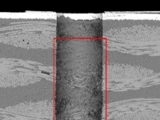
•The non-toughened laminate exhibits brittle failure subsequent to drilling.
•The laminate with toughener material is tougher and devoid of brittle failure subsequent to drilling.
•Moisture uptake does not exhibit a loading dependence above 3.75 wt% toughener loading.
•Critical stress intensity factor (K1C) asymptotes to a plateau above 3.75 wt% loading of toughening aid.
•Strain energy release rate shows a transition in the failure mode from cohesive to adhesive in the vicinity of 3.75 wt% toughener loading
Initially Published in the IPC Proceedings
|