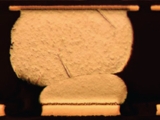
Head-On-Pillow Defect - A Pain in the Neck
The head on pillow defect is becoming more common. This paper describes an occurrence for an OEM and explains how it was dealt with.
DOWNLOAD
Authored By:
Chris Oliphant, Bev Christian, Kishore Subba-Rao, Fintan Doyle, Laura Turbini, David Connell, Jack Q. L. Han
Research In Motion, Waterloo, Ontario, Canada
Summary
The head on pillow defect is becoming more common. This paper describes one such occurrence for an OEM and explains how it was dealt with. In this particular case it was solved by application of problem solving skills by the OEM, component supplier and the solder paste provider.
Conclusions
HoP is a challenging and complex soldering problem with much risk for the OEM. For the OEM, the lack of a reliable test method in mass production leaves the OEM with no choice but to find and test a solution to the point that it can be assumed the HoP is no longer a problem.
From the data collected, it is clear that any mechanism which alters surface oxidation of the BGA ball results in significant variation in the HoP incidence.
The addition of flux dipping, and/or N2 gas reflow both reduced the HoP defect rate to zero. (For practical purposes, zero equals an upper bound estimate (95% confidence) of 0.1% for the true HOP defect rate.
The switching of solder paste also demonstrated a huge affect on the HoP incidence. The testing of Pb-free solder paste from five different 1st Tier suppliers showed that whilst one paste virtually eliminated HoP, another made it over 10 times worse than the original defect rate.
Finally, it would seem that a solder paste with poor slump performance does not do so well in the fight against HoP. This OEM's testing indicated that the worse the slump, the greater the incidence of HoP.
Initially Published in the IPC Proceedings
|