Solving Test Challenges: Razor Sharp Probes
This paper will review how to solve today's test challenges using new innovative razor sharp probe tip styles.
DOWNLOAD
Authored By:
Stacey Marotta, Applications Engineer
QA Technology Company, Inc.
Hampton, NH USA
Summary
Solving today's In-Circuit Test Challenges on Difficult to Probe PCB Targets
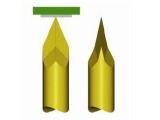
Due to In-Circuit Test issues probing difficult to penetrate processes such as Pb-free solder, OSP (Organic Solderability Preservative), Immersion Au (Gold), Ag (Silver), Sn (Tin) and No-Clean, as well as the different manufacturing process variations like wave, select wave and reflow (single and double), new innovative razor sharp probe tip styles were developed (Figure 1). It was determined that a probe tip that has the qualities of a sharp blade edge would help to penetrate these problem processes. Edge sharpness has been determined to be a critical factor in the successful penetration of these processes within via and test pad applications.
In addition, due to the sharpness of the edge, the penetration is effective even off center of the test via or in the pad area as well. Most tips used to probe vias today contain a single point design with the mentality that this sharp single point will break thru these board processes/contaminants. However, in most cases a single point probe will bottom out in the pool of flux contained within the via resulting in poor electrical contact. A razor sharp tip style will better penetrate these hard to probe fluxes and contaminants without bottoming out. Typically, Test Engineers would be forced to increase the probe spring force to break-through these contaminants, but high-density PCB's do not allow the use of higher spring forces due to the increased possibility of board flex which can cause damage to expensive boards.
The use of the razor sharp probes does not require a higher spring force and in some cases the spring force can be reduced. Because of these innovative tip styles, first pass yields are significantly increased, repeated fixture actuations are not needed, false failure rates and NDF's (No Defects Found) are reduced, all of which results in less test time and faster board throughput which ultimately lowers board test costs.
Initially Published in the IPC Proceedings
Comments
Apr 2, 2014
Given the specific set of circumstances described those aggressive head styles are quite useful. However, there are many circumstances where those aggressive head styles cause issue. OSP boards with soldered test points are problematic. The probe strikes the pad at full extension and least force. If the solder on the pad presents a high aspect ratio at the point of contact the probe slides off and buries in the flux at the base of the pad.
As the pitch of the probes decreases the possibility of deflection increases. On high density OSP boards with large numbers of fine pitch probes the probability that there will be a high aspect ratio contact point is usually 100%. In those cases a small serrated or crown probe is better. Sometimes it is better to use a blunt object rather than a knife.
Matt B.Turpin, Datest, USA
|