Phil
Welcome to Board Talk with Phil Zarrow and Jim Hall of ITM Consulting, the assembly brothers coming to you from the situation room at ITM headquarters high atop Mount Rialto.
What's the question du jour?
Jim
How do we determine what is the best under stencil wipe frequency?
Phil
Wiping the underside of the stencil, we're talking about in process, and the answer is it depends. It's application driven.
Some of the factors include:
- solder paste
- ambient conditions
- how it's reacting
- aperture size
- the range of aperture sizes
But the best way to actually determine it is to do a design of experiment, just like with every other printer parameter. So rather than guessing and doing it hit and miss, bring on the data.
Jim
Get back to basics is always my tendency.
Obviously we don't want to wipe the stencil any more frequently than we have to because it typically costs us money in terms of paper and solvent and consumables.
If you're in a high volume high-speed line where stencil printing could become the limiting gate in the line, stencil wiping typically adds to the overall cycle so you don't want to do it any more frequently than you have to.
But on the other side obviously if you don't do it enough you start to get solder defects, due to the factors my brother was alluding to.
Phil
One thing, interesting to note that a lot of the more modern systems can be equipped where they're utilizing a vision system to actually do an inspection of the stencil.
These systems are good. Of course it depends how they're applied and what apertures you're actually checking.
We still recommend the best thing is direct knowledge.
Do a DOE (Design of Experiments) to actually determine for that given application, stencil, materials etc., you know what the frequency should be along with the materials and the methodology whether using a dry wipe only with vacuum or whether you're using wet followed by a dry.
Jim
One other factor is that if you choose to use a solvent as part of your under stencil wiping, make sure it's an appropriate solvent for the paste you're using.
IPA is not a universal solvent for all solder paste and you can get into trouble by using IPA or any solvent that isn't compatible with a specific paste you're using. And that's true of all cleaning operations.
Phil
You've been listening to Board Talk with Phil and Jim, the assembly brothers.
Whatever you do when you go to reflow, don't solder like my brother.
Jim
And don't solder like my brother.
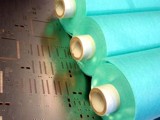
Photo courtesy of High Tech Conversions.
An experiment to determine stencil wipe frequency definitely is in order here. This ground has been tilled before, so there are published designs for these experiments, which usually involve observation of solder clogging at fine pitch stencil apertures. How many times stencil wipes are conducted prior to aperture clogging is key. But the material used in the wiping process also is a concern. If one plans to use a nano coating to improve (lessen) wipe frequency, one should use a soft wipe material, preferably one that does not include any cellulose (paper) content. A synthetic stencil wipe fabric is softer, more absorbent and less abrasive to delicate nano coatings. It will extend the wipe frequency on a stencil and the life of the nano coating.
Adding nano coating to stencils is a proven way to greatly reduce the frequency you need to clean your stencils.