Phil
Welcome to Board Talk. This is Phil Zarrow, Joe Belmonte and Jim Hall of ITM Consulting. What is our question du jour, Jim?
Jim
Our question comes from K.B. and asks, is there a recommended usage rate for stencils? Is there a way to determine when it's time to replace a squeegee or a stencil?
Phil
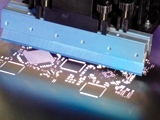
I'll pipe in first. Many is the time that we've seen a stencil damaged because of improper handling, dinged or something, long before its reached its expiration, if you will. Same thing with squeegees and since the majority of people use stainless steel squeegees, don't drop that squeegee. Don't ding the squeegee. Don't use a dinged squeegee.
Jim
Is it fair to say that if you don't drop and ding your squeegees, they will last a long, long time and there is no real predictable end of life for a squeegee. Most of them are ended by being damaged?
Phil
Pretty much so. That's been mostly my experience.
Jim
But stencils are something else?
Joe
Jim and Phil, you're absolutely right. In my career, this is probably the question I've been asked most and unfortunately there's no answer. You have to remember when a person's using a stencil or a squeegee, the conditions vary greatly from one operation to the other, such as the paste they're using, the cycle time, the pressures, the squeegee speeds.
I've personally never seen a stencil wear out. Although I've seen plenty of stencils damaged so the stencil is no longer viable. So as both Jim and Phil said, a stencil and a squeegee should only be one of three places. It should be in the equipment being used, in the cleaner being cleaned, or in a well-designed storage rack. Anywhere else, like up against the bench, on top of a table, leaning up against the machine is an absolute no-no. The biggest enemies of stencils and squeegees are mishandling.
The first thing operators should do before they start the print process is give a quick look over of the squeegee and the stencil. If they have any concern at all, they should notify the appropriate responsible engineer or technician who should take that out of service. You have to remember these are, relatively speaking, low dollar items, low value items, a stencil and squeegee. Why would you risk using a suspect squeegee or stencil to produce defects which cost many, many times the cost of those low value items? I know that most people want to help their company, to preserve the life and save money by not having to buy things but believe me, the right thing to do is take them out of service is there any question at all.
My last point is this. For any high-volume product you have to have a backup stencil. Who wants to lose revenue because of delay for the cost of a relatively inexpensive stencil? For a few hundred dollars, it's a fantastic insurance policy.
Jim
I have a question for you guys. When you're using a stencil with a HASL coated board, hot air solder level, you're oftentimes coming in contact with domed pads. Have either of you ever seen the impact on stencil life because of the tendency to deflect the edges of the apertures as they're coming down on a non-flat surface?
Joe
Jim intuitively that makes sense, but I have never seen any definitive study that would support that, although in perception and logic, that seems to make sense. There are so many variables in the process, you'd have to run a very detailed, long and laborious experiment to come up with data.
Phil
I think, you would see the impact on print quality in terms of the solder paste height and if it's severe enough there would be an effect on gasketing. I never thought about the effect of domed pads but again, they're generally not around long enough.
Joe
We learn as we go.
Phil
And we've also learned that we're out of time for this installment. I thank my cohorts, Jim and Joe and we look forward to your questions. Keep 'em coming.
Jim
And whatever you do, don't solder like my brother.
Phil
And don't solder like my brother.