circuitnet
Sponsor
Advanced Interconnections Corp.
Plan Ahead for BGA Device Upgrades
BGA Socket Adapter Systems convert surface mount device packages to through-hole (pinned) assemblies, making it easy to plug and unplug SMT devices in the field or the test lab.
Advanced Interconnections Corp.
Rentals and Rent to Purchase x-ray Systems
Sponsor
ECD
Maybe it's the thermocouple connection
If your thermal profiling readings seem inconsistent, the culprit could be your thermocouple attachment method. A recently conducted study revealed some interesting findings.
ECD

How to Gauge Solder Paste Volume?


How to Gauge Solder Paste Volume?
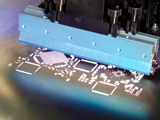
How much solder paste should be applied when running a stencil printing system? Should we print a PWB on the first pass or after few cycles?
Board Talk
Board Talk is presented by Phil Zarrow and Jim Hall of ITM Consulting.
Process Troubleshooting, Failure Analysis, Process Audits, Process Set-up
CEM Selection/Qualification, SMT Training/Seminars, Legal Disputes
Phil Zarrow
Phil Zarrow
With over 50 years experience in PCB assembly, Phil is one of the leading experts in SMT process failure analysis. He has vast experience in SMT equipment, materials and processes.
Jim Hall
Jim Hall
A Lean Six-Sigma Master Blackbelt, Jim has a wealth of knowledge in soldering, thermal technology, equipment and process basics. He is a pioneer in the science of reflow.

Transcript

Phil
Welcome to Board Talk. This is Phil Zarrow and Jim Hall, the Assembly Brothers, also by day going as ITM Consulting. We have a printing question today. And fortunately for us, we are joined by Joe Belmonte.

Jim
This question is about solder paste. It's from C.T. "How much solder paste should be applied when running a stencil printing system?" And the second part, "Should you print a PWB on the first pass, or should you work the paste a couple of cycles before running the first good board?"

Well, Joe, what do you have to say?

Joe
During my time at Speedline, this was a question that came up frequently. My recommendation is if you have equipment that has a dispenser, is to purchase your paste in tubes and use the dispenser. That way you can have a controlled bead. But obviously, there are many customers who have purchased paste in jars.

We recommend a bead of about one quarter to three-quarters of an inch. The more paste you put on, the more you're exposing to the atmosphere, weakening the paste where problems can occur.

We know that this happens sometimes because folks try to run lines with fewer operators who have several responsibilities. So they load up the paste on the stencil so they can go off to other responsibilities.

But you really have to keep that paste bead to a minimum so not to expose the paste to the atmosphere. Make sure you get the proper rolling, in the hole filled that's required to get a good paste transfer. Jim?

Jim
I think that's very good. But as with all things, it's going to be somewhat paste-specific. It gets back to qualification. That's this other issue of what we'll call kneading the paste, getting it rolling before you actually start printing.

Some machines have a kneading feature on them which you can activate, and it will actually move the squeegee back and forth in both directions a couple of times to knead or activate the paste into a good rolling condition.

Do you need that or can you just go ahead and print on the first board? It's really a function of the paste. All the manufacturers try to formulate a paste so that as soon as you dispense it, your first pass should be good.

It's the kind of thing you should evaluate when you do your paste qualification.

To be safe, if you don't have a kneading feature, you can print a couple of cycles back and forth on a scrap board before you actually put in a good board to print.

It's something that you should determine for your conditions and the specific paste that you're using.

Phil
We're talking about application specificity. The materials you're using, the actual application, the machine you're using, and your particular environment.

Jim
One another thing. Most paste manufacturers work hard to make the paste less sensitive to the environment so that the problem of having too much paste and letting it sit is reduced. But it's still a good practice to minimize solder paste exposure.

Joe
I just had one other quick comment. Folks often underestimate the sophistication of solder paste. Solder paste is an amazingly sophisticated product. We're asking it to do a lot of things. To get the maximum value, you have to do the engineering work to get the best set of parameters to optimize the performance in the paste you're buying.

Phil

You may be buying it as a commodity, but in many respects it is anything but a commodity.

Jim

And don't push your paste any harder than you have to because most solder defects start with printing of paste.

Phil

And speaking of things not to do, don't solder like my brother.

Jim

Don't solder like my brothers, either.

Comments

May 12, 2016
Great discussion on one more key variable in the printing process that needs to be validated and then monitored for best printing practices.

Our company, along with one of our customers, ran a solder paste inspection study based upon this "proper rolling" hypothesis. It was quickly realized by analyzing the SPC run charts and 3D renderings that the first few boards printed without proper kneading provided a very high min to max height variation of 2+ mils and the quality of the print deposition was substandard. After running another handful of boards to allow more time for the paste to roll out, the charts began to flatten out, the 3D solder profiles began to normalize and the process was deemed stable. Theory confirmed! However, there were still a few issues with hot spots on the board, but these were found to be caused by poor board support an other design related challenges.

Somewhat presumptive, but for the most part everyone can build a "good" board with the use of basic printing guidelines and AOI/rework stations to catch and repair the already created solder defects.

The question that really need to be answered is "How do we move away from this type of reactive production mode and move towards a more proactive mode of engineering quality into our boards to make them the "best" boards manufacturing can provide? The most logical answer can be found through the use and implementation of a dedicated Solder Paste Inspection tool. Without such a tool, you are trying to control the most critical process in your production...in the dark.
Steve Arneson, ASC International, Inc.
Submit A Comment
Comments are reviewed prior to posting. You must include your full name to have your comments posted. We will not post your email address.

Your Name


Your Company
Your E-mail


Your Country
Your Comments


Free Newsletter Subscription
Circuitnet is built for professionals who bear the responsibility of looking ahead, imagining the future, and preparing for it.

Insert Your Email Address

Sponsor
Uyemura
RAIG Minimizes Corrosion, Allows Higher Gold on ENEPIG
Paper describes a mixed reaction RAIG electrolyte that minimizes galvanic corrosion and allows higher ENEPIG gold thicknesses, enabling robust designs and world-class quality on target with minimal variation.
Uyemura
Affordable Profiling