circuitnet
Sponsor
Ormet TLPS
Highly Thermally & Electrically Conductive TLPS via Filing Paste
New filing highlights advanced sintered metal paste enabling faster installation, superior heat dissipation, higher conductivity, and reliable thermal drain performance without long processing cycles.
Ormet TLPS
Critical Considerations for Tin Whisker Mitigation
Sponsor
Summit Interconnect
Your Domestic PCB Solution
Summit helps you avoid long lead times and added costs—protecting your supply chain without compromise, while delivering the speed and quality you count on.
Summit Interconnect

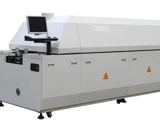
Recommended Board Spacing During Reflow


Recommended Board Spacing During Reflow
Modern forced-convection reflow ovens generally maintain thermal profiles even when heavy boards run end-to-end. The main risk is handling, not heat recovery. Validate with worst-case boards, then use a small gap as needed to prevent collisions during loading and unloading.
Board Talk
Board Talk is presented by Phil Zarrow and Jim Hall of ITM Consulting.
Process Troubleshooting, Failure Analysis, Process Audits, Process Set-up
CEM Selection/Qualification, SMT Training/Seminars, Legal Disputes
Phil Zarrow
Phil Zarrow
With over 50 years experience in PCB assembly, Phil is one of the leading experts in SMT process failure analysis. He has vast experience in SMT equipment, materials and processes.
Jim Hall
Jim Hall
A Lean Six-Sigma Master Blackbelt, Jim has a wealth of knowledge in soldering, thermal technology, equipment and process basics. He is a pioneer in the science of reflow.

Transcript

Phil
Welcome to Board Talk. This is Jim Hall and Phil Zarrow, the Assembly Brothers. What's our question for today?

Jim
This comes from K.D. The question is, "When running boards through a convection re-flow oven, should there be a gap between boards of one board length, or will it typically make no difference to have boards running end-to-end in a continuous train to save time and energy? What would you advise?"

Phil
I guess this is where we put on our surface mount myth busters hat. The old tale was to leave an absolute minimum of one board length in between boards, and that had a practicum of truth to it way back when, when we had far less efficient re-flow ovens back in the days of convection IR. Now with forced convection, we have much higher efficiency and heat transfer.

Boards are absorbing energy as they go through the oven. The concern was how quickly can the oven replenish it. In today's world, it's a different matter.

Jim
Obviously, for any given situation to be 100 percent sure, you should test your oven with your worst board. Take your heaviest board. Run it in between three or four other boards of equal size. Run them right next to each other, and see if it changes the profile at all. That's the only way to know for sure.

I've designed ovens for many years and was involved in the initial advancements of high-level convection ovens, and we tested this all the time. I can tell you from my tests with very heavy assemblies that all of the major high-end ovens today can run heavy boards with an aggressive profile, without any space between them, and show no significant change in the thermal profile seen on any board.

The physical reality in actual production is you need to leave some space for handling reasons. Typically, board-on and board-off conveyors are not maxed at the speed, and the worst thing you want to do is have boards crashing into one another or lapping over on top of one another.

Most people leave a couple of inches to allow for any inconsistencies in the on-load and off-load transfer, and that drives how big that gap has to be, not the thermal reaction of the oven.

As Phil says, modern convection ovens re-circulate so much gas, there's so much energy available at any instant in time that they recover and show no appreciable loss of energy, even when running back-to-back heavy boards.

Phil
This question was pretty straightforward to answer.

While you're validating your process, whatever you do, no matter how big your boards are, how big your oven is, whether you're using an oven or whether you're using a vapor phase, or whether you're using a blowtorch, whatever you do...

Jim
Don't solder like my brother ...

Phil
and don't solder like my brother, either.

Submit A Comment
Comments are reviewed prior to posting. You must include your full name to have your comments posted. We will not post your email address.

Your Name


Your Company
Your E-mail


Your Country
Your Comments


Free Newsletter Subscription
Circuitnet is built for professionals who bear the responsibility of looking ahead, imagining the future, and preparing for it.

Insert Your Email Address

Sponsor
Plasmatreat GmbH
Oxide Reduction for Reliable Electronics Manufacturing
As power densities increase and components become smaller, oxide layers and surface contamination become critical manufacturing risks. Discover practical approaches for oxide reduction, cleaning and activation in electronics production. Download the whitepaper.
Plasmatreat GmbH
Test & Inspection