|


|
|

What Causes Exploding Solder Joints?
Board Talk
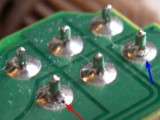
TranscriptPhil We have seen joint voids that look like explosions after wave soldering, some members of the team believe the problem is caused by humidity brought to the process by the bare board. The problem was solved by changing the bare board lot. Have you seen this problem before? Do you agree that the cause is likely due to moisture absorption in the bare boards? Can this suspicious lot of boards be salvaged? Jim There was an article by Paul Litowsky, Alpha Solder on this very problem and he explained it in detail. He lists no less than 36 specific potential causes for blowholes. So, I'm sure you could find anything you want on that list.
Phil Jim Or there is too much flux that just can't get completely activated by preheat. Certainly moisture could be a problem and Paul Lotosky lists that as one of the issues, and if you did see the problem solved by board lot that might be it. It could also be problems with the plating on the plated through holes and some of the other contamination issues that are listed in this article. You might try baking the boards, but you might want to do some contamination investigations on the plating, particularly the barrel of the holes to see if that could be the cause. I said, there's 36 potential candidates for what could be causing it. Good luck. Phil Jim Phil Comments
May 8, 2017
It could be a problem of non euthetic behaviour of soldering league or a mixed problems related to the soldering league pollution.
Pierleonardo Zoppellaro, Carel Industries s.p.a.
Jul 31, 2015
Exploding solder joint or blow holes is caused by trapped air or too much flux and not enough time to preheat out gas.
David Blanchard, Arizona Procoat, LLC
Aug 1, 2014
I totally agree with Mike Hill's comment. These are blow holes caused by out-gassing. We would usually spray that side with flux and run across the wave again. I would check your speed in which you flowed them. You also need to consider humidity, if too high would cause these issues as well. If this is the case you would also see defects in your coating if you conformal coat/humiseal the card.
Fran Guminsky, Fran Guminsky, USA
Mar 30, 2010
Infrequently we see "blisters" (delamination) on a board around certain components after selective soldering. The location of the blisters is not always at the same locations. We tried reducing solder temperature to minimum, but the problem persists and still happens. What could be the root cause of our problem?
Kartick Kudtarkar, H. L. Electronics
Mar 29, 2010
I have to agree with M.H. and add that not only will voids cause the problem but you have to consider thin plating as well. A lot of the offshore boards are coming with plating in the hole less than 0.7 mill-inches. The thin copper in the hole acts like a weak walled pressure vessel and cannot resist the pressure build up from any trapped moisture during the solder process. The weak wall ruptures under pressure and you get a blow hole. If you push the average plating thickness to 1 milli-inch in the hole the problem goes away.
R.K., ICM Controls
Oct 27, 2009
Most likely the plating in the through holes is not continuous and has voids. When these non-plated laminate areas inside the holes see soldering temperatures, the moisture in the laminate vaporizes resulting in "blow holes" in the solder.
A simple micro-section of a hole with a blow hole can be used to conform.
Mike Hill, Colonial Circuits Inc., USA
Oct 26, 2009
Hi Phil and Jim. We've been sitting here in the UK listening to a few of your shows, and we'd like to point out that your pronunciation of the word "solder" sounds an awful lot like "soder." Thanks for the shows!
Arthur
|
||||||||


|
Free Newsletter Subscription
Circuitnet is built for professionals who bear the responsibility of looking ahead, imagining the future, and preparing for it. Insert Your Email Address |
|


|