|

|
|

Mixed Cleaning - No Clean and Water Soluble
Board Talk
TranscriptPhil Jim The solder chemistry is the same, 63/37, but the manufacturers are different. Of course, one is no-clean and one is water-soluble. Does this pose potential problems for the assembly or equipment? I prefer not to introduce the no-clean into my SMT environment, since the system is closed-loop. Phil Jim Phil Jim Some can be cleaned with water and a saponifier, others require very special solvents and cleaning processes so you have to match the cleaning processes for no-clean to the specific no-clean flux formulation you're dealing with. There is no universal solvent, IPA, or anything else that's going to get it all off. It's a common mistake that any people make. But most importantly you're not going to clean it with pure water. Phil Jim Phil Jim
Phil Comments
Feb 5, 2026
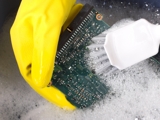
Cleaning a no-clean flux with DI water alone can introduce risk, depending on the flux package and the reflow conditions. Some no-clean residues will turn white or haze when exposed to water only, others will not. Either way, it is a potential risk if the process is not well understood. That said, there are many companies successfully cleaning both OA (water-soluble) and no-clean flux residues in the same wash machine, using the same wash bath, with years of production data showing no reliability risk.
The key to any successful cleaning process is a proper final rinse. We always say you are only as clean as your final rinse. If the rinse is done correctly, there is no concern about leaving behind the cleaning agent or flux residues, whether OA or no-clean.
Debbie Carboni, KYZEN
Oct 24, 2017
Applying WS flux after any no clean process is not recommended for a number of reasons. Many no clean fluxes cannot be removed by water alone and the residue properties can be adversely impacted with exposure to liquid water at pressure and temperature. Also, the ionic components of the WS flux can be absorbed by the remaining no clean residue and alter the residue properties. If cleaning must be performed, all residues should be removed which usually requires the addition of wash chemistry to the cleaning process.
Timothy ONeill, AIM
Dec 2, 2016
We are exploring something similar to what Bill @ Smart Sonic mentioned. Is there a problem with cleaning a No-clean board?
On some of our products we would like to build the double side SMT with No-Clean but later install some hand soldered parts with OA. Followed by washing the assembly. The reasoning behind this would that hand soldering with no-clean tends to have more residue than OA and in addition using no-clean for double side SMT does not require an immediate wash. We are evaluating the process. Some no-clean materials show the white residue when cleaned. Any experience?
Gregory Cronin, CASE Assembly Solutions Inc
Mar 5, 2015
Regarding mixing OA with No-clean. You say water will not clean the no-clean, but as no-clean does NOT require cleaning, my question is: will the water "hurt" the no-clean? If not, you should end up with the water washable being cleaned and the no-clean still "no-clean (not cleaned). Or, will the no-clean develop a "white residue", etc.?
Bill Schreiber, Smart Sonic, USA
Sep 30, 2009
At one time we used Alpha 6100 series no clean. It had a very long stencil life and it never dried to a hard crusty material. You could place "Late Parts" a couple days later and things would solder OK.
The big problem was cleaning a board after rework, you can not remove the no clean flux, it makes a mess. So we gave up and used WS, late parts became hand soldered parts. Is there anything out there that you know of that is a "None Complete Dry Out" WS flux? I would love to know. I deal with loads of quick turn proto and short runs. Holding a placed job before reflow is important.
Bob Kondner
|
||||||||


|
Free Newsletter Subscription
Circuitnet is built for professionals who bear the responsibility of looking ahead, imagining the future, and preparing for it. Insert Your Email Address |
|


|